What Couples Don't Realize About Losing Intimacy: the Effects of Lack of Intimacy
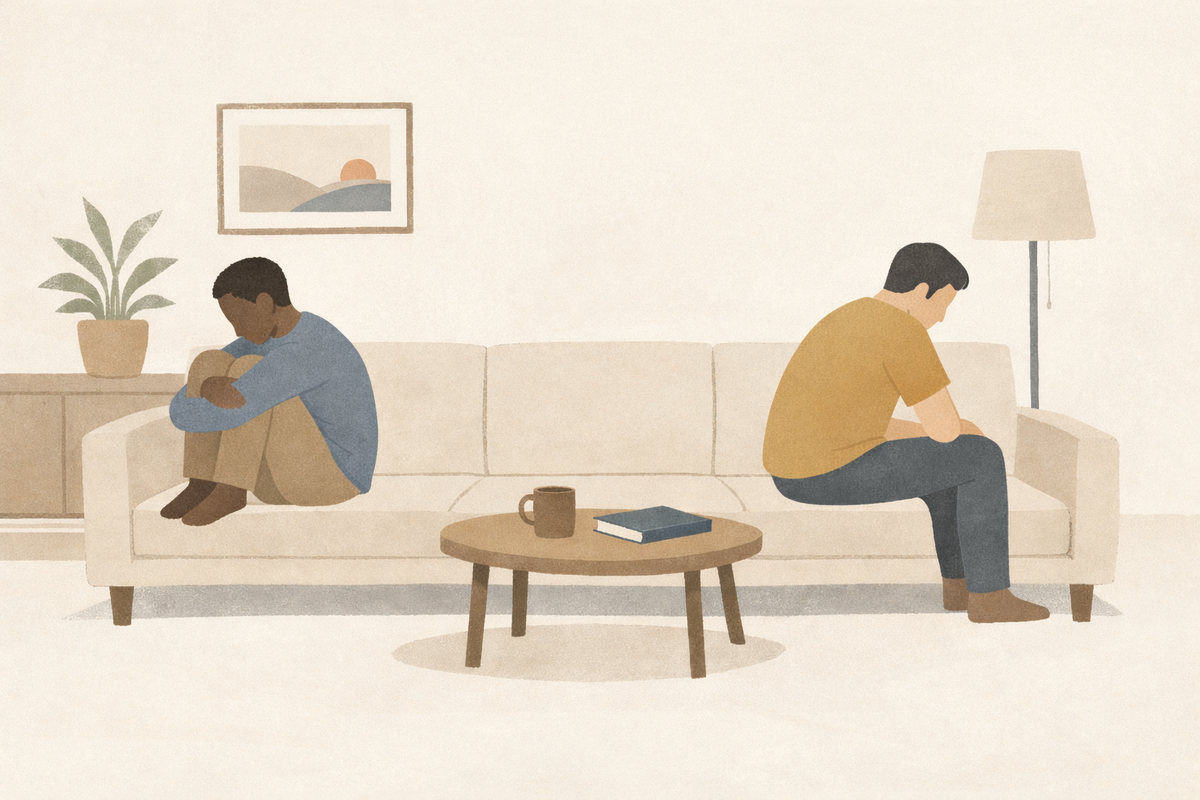
It usually doesn't happen all at once. But the effects of lack of intimacy are felt long before they are understood or named. There is no single moment where both partners sit down and say “something is missing”. Instead, the change begins to show up in how the relationship feels from the inside. You might notice a quiet sense of distance, a sense of loneliness, or a growing hesitation to reach for each other. Conversations become more practical than personal. Physical touch becomes less natural, then less frequent, until its absence feels easier to ignore than to question.
What are the effects of lack of intimacy on a relationship?
*The effects of lack of intimacy reach further than most couples realise. The relationship becomes more functional, more transactional, quieter at its emotional core. But the deeper effects are individual: self-worth quietly erodes, a particular kind of loneliness sets in, and the impulse to reach for your partner gradually goes underground. These effects are signals, not verdicts. They point toward something that has been unattended for a while. Recognising them is usually where things begin to change.
For a broader look at why intimacy fades and what genuinely helps, see our guide on lack of intimacy in a relationship.
What this article covers
- Why are the effects of lack of intimacy so hard to see at first?
- Why does lack of intimacy feel so painful?
- What does lack of intimacy actually do to you over time?
- What is the effect of lack of intimacy on the relationship itself?
- Why do couples adapt to low intimacy instead of addressing it?
- Does lack of intimacy mean the relationship is broken?
- How does lack of intimacy affect the way you see yourself?
- Moving toward reconnection without pressure
- A closing thought
- Frequently Asked Questions (FAQ)
Why are the effects of lack of intimacy so hard to see at first?
The effects of lack of intimacy in a relationship are confusing precisely because they do not arrive the way most problems do. And one of the most confusing things about realizing the effects of lack of intimacy, is how subtle it feels in the beginning.
There is no clear breaking point. Instead, there is a gradual shift from connection to coexistence. You still function well as a team. You manage responsibilities. You may even enjoy each other's company in certain moments. So it is easy to assume: we are fine. This is just what long-term relationships look like. It's the same everywhere, for everyone, right?
And in some ways, that belief is protective. It stops you from panicking over something you cannot yet name. But over time, something deeper starts to change. Because intimacy is not just about closeness in the obvious sense. It is about how we experience ourselves in the presence of another person. It is the quiet background reassurance that says: you are seen here, and you matter.
When that reassurance is consistently present, most people do not consciously notice it. It is simply the air the relationship breathes. When it fades, something starts to feel thin, even when nothing visible has changed.
Why does lack of intimacy feel so painful?
This is the question many people struggle to put into words.
Why does it affect me this much? Nothing bad is happening on the surface. There may be no major conflict, no betrayal, no obvious crisis. You think "intimacy probably will come back, and do these effects of lack of intimacy really matter?". And yet the absence of intimacy can feel deeply unsettling, sometimes more unsettling than problems that would seem more serious.
The reason has to do with what intimacy actually does for us, not just between two people, but inside each one.
Intimacy is one of the main ways we feel reassured in a close relationship. Not through grand declarations, but through small, consistent moments of responsiveness. A look. A touch. A genuine response when you say something. When those moments are present, the unspoken questions of closeness get answered without needing to be asked. Do I matter to you? Am I wanted here? Do you still see me? When intimacy fades, those questions do not disappear. They just lose their answers.
And that unresolved state, even when it is subtle, creates a kind of low-grade emotional discomfort that is very hard to name, and very hard to shake. Over time, the absence can begin to feel like rejection without explanation. And the mind, searching for meaning, naturally tries to fill in the gap.
What fills that gap is the real subject of this article.
What does lack of intimacy actually do to you over time?
The effects of lack of intimacy are rarely limited to the relationship itself. They begin inside each partner, shaping how each person feels, thinks, and shows up, often before either person has fully registered that something has changed. What follows is what those effects actually look like from the inside.
You start to question yourself in quiet ways
Intimacy is one of the ways we feel chosen. It says: out of everything and everyone, I am still here, with you, paying attention to you. When that feeling fades, many people begin, almost without noticing, to internalize the absence.
The thoughts are rarely dramatic. They tend to be quieter than that. Maybe I am not as attractive as I used to be. Maybe I have become boring. Maybe I ask for too much. Maybe I am just hard to love. These thoughts do not feel like interpretations. They feel like observations. And even when a person logically knows they are not the full story, they can still take root.
Over time, these quiet interpretations begin to shape behaviour. You may dress slightly less like yourself, because being seen feels complicated. You may hold back a thought, because sharing it seems likely to be received with half-attention. You may stop asking for what you want, because asking has started to feel like a small defeat. Each adjustment is tiny. Together, they add up to a version of you that is considerably more guarded than the person who entered the relationship.
A particular kind of loneliness sets in
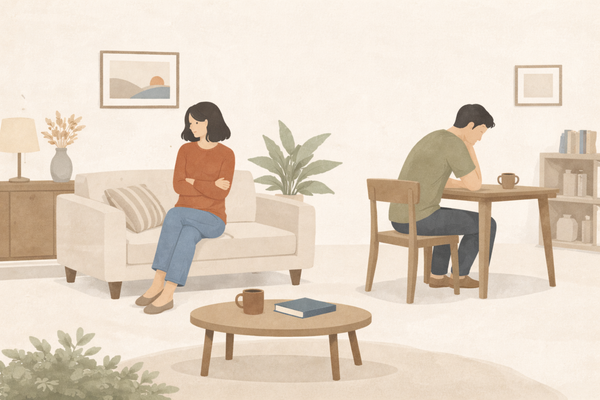
It is not the loneliness of being physically alone. It is the loneliness of being physically present but emotionally somewhere apart. You share a home. You share a life, a calendar, a set of routines. And yet something essential feels absent.
This kind of loneliness is especially hard to talk about because it seems almost ungrateful. My partner is right there. Why do I feel this alone? But the feeling is real, and it is common, and it deserves to be taken seriously rather than dismissed. Much of the research on long-term relationships suggests that this form of loneliness, the loneliness inside closeness, is more corrosive to wellbeing over time than the loneliness of being single. It takes longer to recognise, because the surface of life looks full.
You begin to reach less
Among the most lasting effects of lack of intimacy is what it does to the impulse to reach for connection at all. This happens gradually, and mostly without anyone deciding to let it happen.
If reaching toward your partner has been met with distraction, or with a kind of friendly unavailability, you learn, at a level below conscious thought, to reach less. You share less. You ask for less. You stop starting the small conversations that used to happen naturally. The desire for connection does not go away. It simply goes underground.
What replaces it is often a learned resignation that is easy to mistake for acceptance. Couples in this state frequently describe themselves as "fine" or "settled" when what has actually happened is that both people have quietly stopped expecting much. This is not the same as contentment. It is what emotional retreat looks like when it happens slowly enough that no one names it.
When both partners have withdrawn their reaching to this degree, the relationship can feel calm on the surface and quietly empty underneath. This is distinct from the pursue-withdraw cycle explored later in this article, in which one partner is still reaching, often with increasing urgency, while the other pulls back.
You become a quieter version of yourself
Without realising it, you may begin to show less of who you are within the relationship. The parts of you that needed to be seen and responded to start to recede. Not because you have changed as a person, but because the environment has stopped making space for them.
Over time, this can feel like a loss of identity, or at least a loss of the version of yourself that used to feel most at home in this relationship. The humour that used to land. The small enthusiasms that used to get shared at the kitchen table. The side of you that was a little silly, a little bold, a little more alive. None of it has gone. It has just stopped being invited. And when a version of you has not been invited into the room for a long time, it becomes harder to remember it is there at all.
This is often the quietest effect of lack of intimacy, and the one that takes longest to notice. You may only realise it when something, an old friend, a holiday, an unexpected conversation with a stranger, briefly pulls that version of you back into the air. And you feel, with a kind of surprise, more like yourself than you have felt in a while.
A note before you begin reflections
There are a few short reflection exercises in this article. If you are the partner who tends to notice these things first, who reads the articles, who carries the awareness of the relationship, they are not more work for you to do alone. They are most useful when they eventually belong to both of you.
If your partner is not ready to hear this yet, or responds in a way that closes things down rather than opens them, that is not a failure. Sometimes the first time you try is the practice, not the conversation itself.
✦ Pause and Reflect #1: how each of you reaches
For yourself: Think about how you and your partner tend to reach for each other. Some people reach often and visibly: a touch, a question, a comment across the kitchen. Some reach quietly and hope it's noticed: being in the same room, making a cup of tea, a look. And some have mostly stopped reaching at all, because somewhere along the way it started to feel harder than it was worth.
Which of those is closest to you right now? And which is closest to your partner? There's no better or worse here. You're just seeing the pattern. Patterns tend to change once they're actually seen, rather than assumed.
To bring to your partner:
Something you could say: "I don't think we reach for each other the way we used to. I'm not sure either of us does. Can we talk about that? Not as anyone's fault, just as something we've both been in?"
The phrase "not as anyone's fault" matters. These conversations survive or collapse on that one idea.
What is the effect of lack of intimacy on the relationship itself?
The effects of lack of intimacy are not limited to how each partner feels internally. They also reshape the texture of the relationship itself in ways that are easy to explain away.
Conversations become purely practical
What begins as a relationship full of personal sharing, curiosity, and humor gradually shifts toward the functional. You discuss schedules, logistics, and decisions. You coordinate and manage. These conversations are necessary. But when they become the primary mode of interaction, something of the emotional texture of the relationship quietly disappears. There is less genuine surprise. Less discovery. Less of the sense that you are actually meeting each other rather than just running a shared operation.
Both partners start telling themselves a story
When intimacy is low and explanations are absent, the mind generates its own. We have grown apart. They are not interested in me anymore. This is just who we are now. These interpretations often feel like conclusions rather than guesses. They shape how partners look at each other, how they respond to small moments, and whether they continue to invest emotionally. And once a story about the relationship has formed, it takes effort to step back and question it.
The pursue-withdraw cycle
Of all the dynamics that emerge in the low-intimacy phase of a long-term relationship, this is the most common and the most painful. It is worth understanding in detail, because once it takes hold, it shapes nearly everything else.
The pursue-withdraw cycle, described by Sue Johnson who developed Emotionally Focused Therapy, is the pattern in which one partner reaches for closeness with increasing urgency while the other pulls back under the weight of that pressure. Both responses driven by the same underlying fear of disconnection, from opposite directions. One partner reaches because distance feels threatening. The other retreats because pressure feels threatening. Neither is wrong. Together, they lock the couple into a cycle that the usual attempts to fix things, more conversation, more reassurance-seeking, more space, tend to make worse rather than better.
What the cycle actually looks like
The pursuing partner, feeling the distance and wanting to close it, reaches out with more intensity. They ask questions, seek reassurance, or express frustration about the lack of closeness. Underneath these attempts is a quieter request: tell me I still matter to you. Without realising it, they often reach in ways that carry more weight than they intend. The conversation becomes more urgent. The need for an answer becomes more visible. And the partner on the receiving end, already depleted, feels the pressure rather than the longing underneath it.
The withdrawing partner, feeling overwhelmed or pressured, pulls back. Not because they have stopped caring, but because every reach now arrives as another demand on a system that already feels over-extended. Withdrawal can look like emotional distance, physical distance, or simply a kind of friendly unavailability, the sense of being with someone who is nearby but not quite there. From the outside, it can read as indifference. From the inside, it is usually self-protection.
And here is what makes the cycle so hard to step out of: each partner's strategy confirms the other's worst fear. The pursuer's increasing reach confirms to the withdrawer that closeness means demand. The withdrawer's retreat confirms to the pursuer that they are not wanted. Both become more entrenched. Both become more alone.
The arguments that aren't really about the argument
Underneath many of the arguments that seem to be about small things, this dynamic is often quietly at work. A disagreement about who forgot to do what, who is contributing more, who is too sensitive or not sensitive enough, is rarely just about that. It is often an expression of a need that has not been named directly. For the pursuer: I need to feel that I matter to you. For the withdrawer: I need to feel that I will not be consumed by this.
Neither of these needs is wrong. They are simply hard to voice in the middle of a cycle that has been running for a long time, because by the time the cycle has taken hold, voicing a need directly has started to feel riskier than arguing about the small thing instead.
What begins to break the cycle
What the cycle most needs is not a change in behaviour but a change in understanding. When both partners can see the pattern for what it is, rather than reading withdrawal as indifference or pursuit as neediness, something tends to shift. Not immediately, and not completely. But the cycle loses some of its grip, because the meaning each partner attaches to the other's behaviour begins to change.
This is one of the reasons Emotionally Focused Therapy, which works directly on this dynamic, has such a strong evidence base for couples in sustained distance. Often, simply being able to name the cycle aloud together, without blame, is the first genuine step toward closeness that either partner has taken in a long time.
If this dynamic feels familiar, the article on why relationships start to feel like roommates explores how the pattern forms alongside other relational drift, and the article on how to rebuild intimacy in a relationship looks at specific practices that begin to loosen it
Why do couples adapt to low intimacy instead of addressing it?
Most couples do not consciously choose distance. They adapt to it.
At first, the absence feels noticeable. Then it feels uncomfortable. Then, gradually, it starts to feel like the new normal. Expectations quietly adjust. The conversation about what is missing never quite happens. Life continues, the relationship continues, and both partners carry on while something important goes unaddressed.
This adaptation makes a certain kind of sense. Raising the subject of intimacy feels vulnerable. It risks rejection. It might lead to a difficult conversation neither person knows how to navigate. And in the absence of a clear way forward, avoiding the subject feels safer, at least in the short term.
There is also something subtler at work. Emily Nagoski's research suggests that context shapes our experience of closeness in ways most people underestimate. When the relational context has become one of low responsiveness and habitual distance, it becomes genuinely harder to access feelings of warmth or desire. Not because they are gone, but because the conditions for them have eroded. This is an important reframe. The flatness that many couples feel is not evidence that they have fallen out of love. It is evidence that the conditions for love to feel alive have gradually been crowded out by other things.
✦ Pause and Reflect #2: the last time it felt alive
For yourself:
When did your relationship last feel genuinely nourishing rather than just functional? Not perfect. Not intense. Just alive, in a way that felt good to be inside. Don't focus on what you were doing. Focus on how you were being with each other. What was different about the quality of attention between you?
If the answer feels far away, that's useful information too. Not a diagnosis, just the honest reading this article has been inviting. A relationship that hasn't felt nourishing in a while is not a broken relationship. It is a relationship that has been running on functioning alone for too long, which is a considerably more common situation than most couples realise.
To bring to your partner:
Something you could say: *"I've been thinking about us. Not about anything being wrong, just about what I miss. Can I tell you?"
Does lack of intimacy mean the relationship is broken?
This is often the fear sitting just beneath the surface of all of this.
If we have lost this, what does it say about us?
But distance does not mean the absence of love. Many couples who are living with the effects of lack of intimacy still care deeply about each other. They still respect each other. They still want the relationship to work. What is missing is not commitment. It is connection. And connection fades for reasons that have much more to do with circumstance than with the health of the underlying bond.
Stress and mental load are among the most significant. When both partners are running on empty, the relationship becomes the last thing to receive their full attention. Precisely because it feels secure enough to deprioritize. Parenting demands narrow the space for intimacy in ways that are profound and often underestimated. Unspoken resentments accumulate and create an emotional static that makes closeness feel more effortful than it should. Pressure around physical intimacy can create a dynamic where both partners avoid the subject entirely, rather than risk another moment of disconnection.
None of these are signs of a broken relationship. They are signs of a relationship that has drifted out of alignment with what both people actually need.
Esther Perel, whose work on desire and long-term love reaches to the heart of this, makes an observation that many couples find quietly liberating. The relationships that struggle most are not necessarily the ones where love has gone cold. They are often the ones where two people have become so enmeshed in the practical reality of shared life that they have stopped seeing each other as separate, interesting individuals. The solution is not more effort in the usual sense. It is more curiosity. More willingness to look at the person across the table as someone whose inner world is still unfolding. Still worth asking about.
If you are trying to put words to what exactly has gone quiet between you, it helps to start with what lack of intimacy actually means.
How does lack of intimacy affect the way you see yourself?
The effects of lack of intimacy reach into a place most couples don't think to look: not just the relationship, but each partner's sense of their own worth within it. It does not just change how you feel about your partner. It changes how you feel about yourself.
Over time, the absence of being genuinely seen, of being responded to with warmth, can quietly erode a person's sense of their own worth within the relationship. You may feel less desirable. Less expressive. Less confident in what you need. You might find yourself becoming a quieter version of who you used to be. Not because you have changed, but because the environment has stopped reflecting back the parts of you that used to feel most alive.
This is often the deeper pain that people struggle to put into words. It is not simply that we are less close. It is that I do not feel fully like myself with you anymore.
And that is a loss worth taking seriously. Not with blame, and not with alarm, but with honest recognition. Because when both partners can see not just what the relationship is losing, but what each of them is losing individually, it often opens up a different kind of conversation. One that is less about fixing the relationship and more about genuinely understanding each other again.
Moving toward reconnection without pressure
If there is one thing that tends to make intimacy harder to recover, it is pressure.
Pressure to fix it quickly. Pressure to want it. Pressure to perform closeness on a timeline. The irony is that the urgency people feel when they recognize the effects of lack of intimacy often creates the very conditions that make reconnection harder.
What tends to help is a different orientation entirely. Not effort in the sense of doing more, but presence in the sense of being more genuinely available. Small moments of actual attention. Putting the phone down and responding to something your partner said. Asking a question that is not about logistics. Noticing something about them that you have stopped noticing. Understanding the difference between emotional and physical intimacy can also help clarify which dimension has been most affected, and which needs the most attention first.
Sue Johnson's research is consistent on this point. What people need most in a close relationship is not performance or grand gestures. It is the felt sense of emotional availability. The experience of reaching and being met. That experience does not require perfect conditions. It can begin in the smallest moments. A real response. A moment of eye contact. A willingness to be there when the other person reaches, even imperfectly, toward you.
Intimacy does not usually return through effort alone. It returns through safety. Through the slow rebuilding of the sense that this is a place where I am seen, where I can reach, and where I will be met. And that process is always quieter, slower, and more human than most people expect it to be.
✦ Pause and Reflect #3: meeting one moment
For yourself:
Put a hand somewhere on your body. Your chest, your stomach, wherever feels natural, and take a couple of breaths that's slower than usual.
Now think forward to the next day or two. There will be ordinary moments when your partner says or does something small. A comment in passing. A sigh. A question before bed. A look that carries more than it says.
Choose, in advance, to actually meet one of those moments. Not with a solution. Not with advice. Just with real attention, for whatever length of time you can give it. You don't have to prepare anything. You just have to not quite sleepwalk through one moment that was already going to happen anyway.
To bring to your partner:
Something you could say: "I want to be more here with you this week. Not in a big way. Just more there when you reach for me."
A closing reflection
Many relationships do not end in conflict. They fade in quiet disconnection. Not because love disappears, but because intimacy gradually slips out of focus. And the effects of that, while subtle at first, reach further than most people realize.
They reach into how you feel about yourself. Into how you interpret small moments. Into how much of yourself you bring to the relationship. Into whether the relationship feels like a source of nourishment or simply a shared arrangement that keeps on running.
But these effects are not fixed. They are not verdicts. They are signals. Pointing toward something that has gone unattended for a while, and that can, with care and with patience, begin to find its way back.
If something feels missing, it does not mean something is broken. It may simply mean that something important has been waiting quietly for the right conditions to return.
Noticing that, without judgment, is often enough to begin.
What to remember
#2 You may start to question yourself in quiet ways, experience a particular kind of loneliness inside physical presence, and gradually reach less without quite deciding to.
#3 These effects are signals, not verdicts. They point toward something that has been unattended, and can begin to find its way back once it is noticed.
#4 The pursue-withdraw cycle that often takes hold in this phase is not a sign of incompatibility. Both partners are responding to the same underlying fear of disconnection, from opposite directions.
Where to go next
Depending on where you are in the rebuilding process, a few other articles in this series may be useful.
If you are still trying to put words to what has faded between you, our article on what lack of intimacy actually means helps locate the feeling more precisely.
If you recognise the pursue-withdraw cycle in your relationship and want to understand why it is so hard to step out of, our article on the effects of lack of intimacy goes into that dynamic in depth.
If you are navigating the specific postpartum version of all of this, our article on lack of intimacy after having a baby explores the physiological and relational dynamics of that period.
Frequently Asked Questions (FAQ)
What are the most common effects of lack of intimacy in a relationship?
The most common effects are a quiet erosion of self-worth, a particular kind of loneliness that coexists with physical presence, and a gradual withdrawal from reaching for each other. Over time, both partners can end up in a relationship where neither is really connecting, without either having decided to stop.
Can lack of intimacy cause depression or anxiety?
Yes. The absence of consistent emotional responsiveness from a close partner creates a low-grade state of unresolved need that can manifest as anxiety, low mood, or a loss of identity within the relationship. Sue Johnson's research on attachment describes this as one of the most significant sources of adult emotional distress.
How long can a relationship survive without intimacy?
There is no fixed answer. Many couples function for years with reduced intimacy, particularly when practical commitment is strong. But the longer it goes unaddressed, the more both partners adapt to distance as the norm. And the harder it becomes to restore the conditions that allow closeness to return.
Is lack of intimacy always the fault of one partner?
Rarely. The effects of lack of intimacy tend to develop through shared patterns: one partner withdraws, the other pursues, both responses feel justified, and the cycle reinforces itself. Assigning blame usually makes the dynamic harder to change. Understanding the pattern, rather than the person responsible, is more useful.
What is the first step toward rebuilding intimacy?
The most consistent finding from relationship research is that small moments matter more than grand gestures. Responding genuinely to one bid for connection, a comment, a look, a question, begins to rebuild the felt sense of being met. That experience of reaching and being received is where safety, and then closeness, starts to return.
About the research
This article draws on work by Sue Johnson, Emily Nagoski, and Esther Perel.
Written by the BetweenUs editorial team. We write about long-term relationships, intimacy, and desire, grounded in psychological research, without quick fixes.