Why Your Relationship Feels Like Roommates and What It’s Really Telling You

For many couples, the moment of realising something has changed comes quietly.
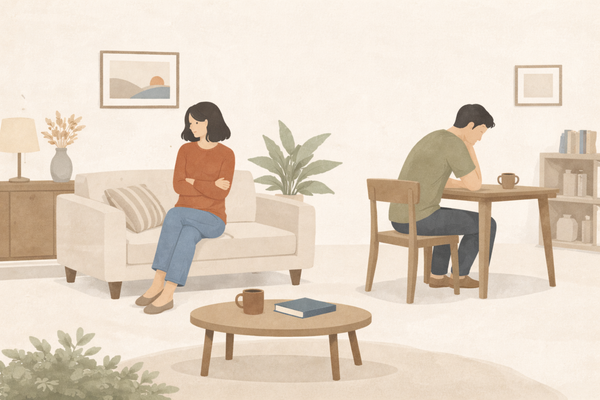
Not during a fight or a crisis, but in the middle of an ordinary Tuesday evening. You are sitting next to the person you love. The house is in order. And yet it feels more like living with a roommate than being with a partner. Something warmer feels just out of reach.
This is one of the most common signs of a lack of intimacy in a long-term relationship. Not dramatic. Not sudden. It is a slow fading of something that once felt more alive.
It does not mean your relationship is failing. It does not mean the love is gone. It usually means that something important to both of you has slowly moved out of focus. And understanding what is happening is often the first step toward change.
What it means when your relationship feels like roommates
For a broader look at the causes and what genuinely helps, see our guide on lack of intimacy in a relationship.
What this article covers
- Is it normal for a relationship to feel like roommates?
- Why does a relationship drift toward the roommate dynamic?
- Do love and desire need different things to survive?
- What are the hidden dynamics that keep couples stuck?
- Is feeling like roommates the same as falling out of love?
- What is the "my relationship feels like roommates" phase actually telling you?
- How can you move past the roommate dynamic?
- Closing thought
- Frequently Asked Questions (FAQ)
Is it normal for a relationship to feel like roommates?
For long-term couples, this experience is far more common than most people realise. And far less alarming than it initially seems.
Almost every relationship, given enough time and enough life, moves through periods where the emotional texture thins. This doesn't mean something has broken. It usually means the relationship has adapted, quietly and gradually, to the demands of shared life. Work, finances, children, ageing parents, health worries, logistics. All of it lands somewhere, and often, it lands in the middle of the relationship.
What makes this shift so hard to catch is that it happens slowly, through moments that seem entirely unremarkable at the time. A conversation gets shortened because the day has been long. A thought goes unshared because it doesn't feel important enough to bring up. A moment that might have turned into connection passes by while attention is elsewhere. Individually, each of these moments is easy to understand. But over time, they accumulate. And in accumulating, they quietly reshape the emotional climate of the relationship.
John Gottman and Julie Gottman call these small attempts to reach for each other emotional bids. A funny observation, a sigh at the end of the day, a light touch on the arm while passing through a room. Each one carries a quiet underlying question: are you with me? When bids are consistently missed, not out of indifference but because attention is so divided, the relationship begins to feel quieter. More transactional. More co-existing. This, more often than not, is where the lack of intimacy in a relationship starts to show up as the roommate feeling.
Why does a relationship drift toward the roommate dynamic?
Understanding how this happens isn't about assigning blame. It's about recognising the very human dynamics at play. Because when you understand what's actually going on beneath the surface, it becomes much easier to stop interpreting the distance as a verdict on the relationship.
When stability becomes the whole relationship
Every long-term relationship naturally moves toward stability. This is not a failure; it's part of how love matures. Stability allows you to trust each other, to build shared structures, to rely on the relationship as something secure. But stability also introduces a subtle shift in focus. The relationship begins to revolve more around maintaining what works than around experiencing it. Schedules are optimised. Roles become efficient. Daily life is coordinated smoothly. And quietly, without either partner intending it, the relationship can begin to feel less like something you inhabit together and more like something you manage together.
When the relationship becomes mostly logistics
One of the clearest signs of this drift is what happens to conversation. The things you talk about most become practical: planning, coordinating, problem-solving, deciding. These conversations are necessary; they keep life moving. But when they dominate, something else tends to fade. The conversations that are not about achieving anything. The ones that exist simply to share, to wonder, to connect. The emotional tone of the relationship shifts. It becomes quieter. More neutral. More like two people occupying the same space than two people genuinely turned toward each other.
The missed moments that shape a relationship
Research on long-term relationships has identified something specific about how this drift happens, and naming it tends to change how couples understand the roommate feeling.
An emotional bid is any small attempt one partner makes to reach for the other throughout a day. A comment about something funny. A sigh that carries more than it says. A light touch on the arm while passing through a room. A glance across the dinner table. John Gottman, whose longitudinal research on couples has tracked what actually sustains connection across decades, identifies bids as the basic unit of intimacy in a long-term relationship. Each one carries a quiet underlying question: are you with me?
When bids are met, with attention, with a response, with even just a moment of genuine presence, they accumulate into something significant. The felt sense that you are seen, that you matter, that the person across from you is still turned toward you. When they are missed, not out of cruelty, but because life is full and attention is scattered, something slowly contracts. Not explosively. Just quietly, over time.
Most couples who describe feeling like roommates cannot point to the moment things changed. Because there was not one. There were hundreds of small moments that passed unremarked, and the sum of them became distance.
This is why the roommate feeling is so hard to address through effort alone. The thing that has faded is not a grand feeling. It is the quality of attention inside ordinary moments. Which means it is not restored through grand gestures either. It is restored, if it is restored, through the same kind of small moments that let it fade.
Sue Johnson, the developer of Emotionally Focused Therapy, adds a complementary insight: emotional connection depends fundamentally on responsiveness, on moments where partners feel that their inner world is genuinely interesting to the other person. Not just their opinions about practical matters, but their experience, their feelings, their inner life. Responsiveness is what turns a bid into a moment of connection rather than just a passing comment.
What stress does to the body's capacity for closeness
It's worth naming something that doesn't get discussed enough in conversations about relationship drift: the impact of chronic stress on our capacity for connection. Stephen Porges's work on the autonomic nervous system helps explain this. When we are under ongoing pressure, financial strain, parenting demands, work stress, physical exhaustion, the body prioritises efficiency and self-protection. Warmth, playfulness, curiosity, and openness are not survival functions. They require a sense of safety and ease to emerge. When daily life is relentlessly full, the conditions for closeness erode, not because love has gone, but because the nervous system no longer has the room for it.
This is not a moral failure. It is a physiological reality and recognising it tends to bring a great deal of relief.
A note before you begin reflections
There are a few short reflection exercises in this article. If you are the partner who tends to notice these things first, who reads the articles, who carries the awareness of the relationship, they are not more work for you to do alone. They are most useful when they eventually belong to both of you.
If your partner is not ready to hear this yet, or responds in a way that closes things down rather than opens them, that is not a failure. Sometimes the first time you try is the practice, not the conversation itself.
✦ Pause and Reflect #1: an ordinary evening
For yourself:
Picture an ordinary evening at home recently. Not a good or difficult one. Just a typical one. Where were you each in the room? What was the quality of the space between you? Not what was said or done, but the feel of it.
Now notice, without judging it: did that space feel warm, neutral, or a little far away? There's no right answer. You're just getting an honest read on where things actually are, rather than where you think they should be.
If something uncomfortable comes up, you don't have to do anything with it yet. Noticing honestly is already a form of care.
To bring to your partner:
Something you could say to your partner, when the moment feels right:
"I realised I don't really know what your week has been like inside your head. Not the logistics, the inside. Tell me?"
If your partner seems tired or caught off guard, that's okay. You're not asking for a long conversation. You're just opening a door.
Do love and desire need different things to survive?
One of the clearest effects of lack of intimacy in a relationship is what it does to desire. And understanding this requires separating two things most couples assume go together: love and desire are not the same thing, and they are not maintained by the same conditions.
Love deepens through trust, shared history, and reliability. It becomes more stable over time. Desire is far more sensitive to context. It is easily disrupted by routine, exhaustion, pressure, and the flattening effect of familiarity.
Emily Nagoski's research on sexual response offers a useful framework here. She describes desire as having both an accelerator, things that turn us toward connection, and a brake, things that pull us away from it. In long-term relationships, it's rarely that the accelerator has stopped working. More often, the brakes have been quietly pressed for so long, by stress, by pressure, by the absence of mental space, that desire has nowhere to go. It doesn't disappear. It becomes inaccessible. For a deeper look at how emotional and physical desire come apart and interact, see our article on emotional intimacy vs physical intimacy.
What this points to is something that can feel counterintuitive: the way back to desire in a long-term relationship is rarely through trying harder at desire. It is through slowly restoring the conditions, ease, curiosity, safety, presence, that allow desire to surface on its own.
What are the hidden dynamics that keep couples stuck?
Familiarity and the fading of curiosity
In the early stages of a relationship, curiosity arrives naturally. You ask questions because you genuinely don't know the answers. You're discovering someone. Over time, familiarity grows and with it, a set of assumptions that can quietly replace that impulse to explore. I know who you are. I know what you think. I know how you'll respond.
These assumptions create comfort. But they also reduce the frequency with which we actually look at our partner with fresh eyes. And without that quality of attention, the relationship can begin to feel more static. Not worse, but more known, more predictable. Less dynamic.
Esther Perel has written and spoken extensively about how desire in long-term relationships is not simply a function of love or compatibility, but of space, mystery, and attention. Not the mystery of not knowing someone, but the ongoing recognition that your partner is a complex, evolving person. Someone who cannot be fully predicted or possessed, someone you can still, in some ways, be surprised by. When couples stop being curious about each other, they don't just lose interesting conversations. They lose one of the key ingredients of aliveness in the relationship.
When two people become too merged
There is another dynamic that rarely gets named clearly: what happens when partners become so thoroughly intertwined, sharing schedules, responsibilities, decisions, stress, that the sense of being two distinct individuals begins to blur. David Schnarch called this a loss of differentiation: the capacity to remain a separate self while staying emotionally connected.
When you are so merged that you no longer feel like two people in a relationship but like a single unit managing a shared life, something paradoxical tends to happen. The closeness that felt like love begins to feel, at a quieter level, slightly heavier. Attraction depends, in part, on a sense of otherness: the felt sense that your partner is still someone you can discover, not just someone you already fully contain. This is not about creating distance for its own sake. It is about remaining genuinely yourself within the relationship, and allowing your partner to do the same.
✦ Pause and Reflect #2: who you are underneath the role
Most of the reflection exercises in this pillar ask you to notice something. This one asks you to notice something slightly different: the gap between you and yourself, inside this relationship.
Set aside the role you play in the relationship for a moment: partner, parent, co-manager of a household. Underneath all of that, who are you right now? What's interesting to you at the moment, genuinely, for no practical reason? Is there a thought you've been turning over that you haven't said out loud to anyone? A small enthusiasm you've stopped sharing because it felt too minor to mention? An aspect of yourself that doesn't quite fit into the rhythm of shared life?
You don't need to bring this to your partner yet. The exercise is simply to notice that this version of you still exists. Rooms have a way of forgetting who is in them, and so do long relationships. Sometimes becoming reachable by your partner again begins with becoming reachable by yourself.
Is feeling like roommates the same as falling out of love?
This is the quieter question sitting underneath most of the others. Is this what falling out of love looks like? Is the warmth not coming back because it has actually gone? These are not irrational fears. They are the natural response to a real change in how the relationship feels.
But the roommate feeling and the end of love are, in most cases, different things. And telling them apart tends to bring significant relief, because most couples reading this are experiencing the first without realising it is not the second.
The roommate feeling is a change in the relational texture, not in the relational bond. Love is still there. Care is still there. Commitment is usually still there. What has faded is the felt sense of being genuinely met by each other in daily life. This can be restored, often more easily than couples expect, once the underlying conditions shift.
Falling out of love is a different experience. It usually involves a gradual withdrawal of emotional investment, a loss of interest in your partner's inner life, a quiet indifference toward what happens to them. Couples who have actually fallen out of love tend not to lie awake wondering what happened to the closeness. They tend not to search for articles like this one. The fact that you are noticing the distance, and that it bothers you, is itself meaningful information.
A clearer way to tell them apart: couples in the roommate phase still want the closeness back. They may feel unsure how to find it, or tired from trying, or quietly worried it will not come. But the wanting is still there. Couples who have fallen out of love often describe something different. Not a wanting they cannot access, but a wanting that has genuinely gone.
If you are reading this and the wanting is still there, the distance you are feeling is almost certainly drift rather than the end of love. That is not a guarantee the relationship will thrive. It is simply information that what is happening is recoverable, and considerably more common than couples in this phase usually realise.
For a deeper look at how ambivalence and genuine uncertainty show up in long-term relationships, our article on what lack of intimacy actually means explores the emotional complexity of this territory.
What is the "my relationship feels like roommates" phase actually telling you?
When your relationship feels like roommates, it's easy to interpret that feeling as a verdict: something is wrong, something has been lost, something needs to be urgently fixed. But it's worth pausing on that interpretation. Because the roommate feeling is rarely evidence of an absence of love. It is usually evidence of a particular imbalance between the relationship as a functional system and the relationship as a living, emotional connection.
Terry Real, who has worked with couples for decades, often points out that many couples become remarkably skilled at functioning together while gradually losing access to the emotional intimacy that gives functioning a point. The relationship runs well. Life is managed effectively. But the felt sense of being truly known, truly met, truly with someone, that has become less frequent, less visible.
Harriet Lerner, in her writing on relationships and communication, makes a distinction that's worth holding onto: the difference between talking and speaking. Most couples in this phase talk constantly, about logistics, decisions, plans. What becomes rare is speaking: sharing something from your inner experience, something uncertain or unfinished, something that makes you a little vulnerable. And yet it is precisely that kind of expression, and the quality of attention it receives, that keeps emotional closeness alive.
Viewed this way, the roommate feeling is not a sign that the relationship has failed. It's a sign that it has been working very hard at the practical level while being somewhat undernourished at the emotional one. That's not a reason for alarm. It's information. And information, at least, is something you can work with. If you are trying to understand more precisely what has gone quiet between you, it helps to start with what lack of intimacy actually means.
How can you move past the roommate dynamic?
It can be tempting to respond to the roommate feeling with urgency. To try to fix it quickly, to have a big conversation, to push toward a different kind of closeness immediately. But pressure rarely unlocks intimacy. More often, it makes it feel heavier. Like another thing on the list, another area where you're somehow falling short.
What tends to help instead is a gradual reorientation. Not doing more, but noticing differently.
Alexandra Solomon, a relationship therapist and researcher at Northwestern University, writes about what she calls relational self-awareness: the practice of staying genuinely curious about both yourself and your partner as people who are still evolving, still changing, still becoming. It's not about interrogating each other or scheduling intimacy exercises. It's simpler than that. It's the difference between assuming you know what your partner is thinking and being willing to ask.
Brené Brown's research on vulnerability offers a complementary insight: emotional closeness cannot exist without a degree of risk. Not dramatic risk, but the small daily risk of sharing something real, an uncertainty, a fear, a hope, without knowing exactly how it will be received. Many couples in the roommate phase have quietly stopped taking that risk, not because they don't trust each other, but because the relationship has become so efficient that vulnerability has started to feel unnecessary. Restoring a little of that willingness to be seen is often where the shift begins.
Perel puts it plainly: in long-term relationships, desire has to be tended. It doesn't maintain itself. But tending doesn't mean performing or forcing. It means paying attention. Creating small, deliberate spaces where you and your partner are more than co-managers of a shared life. Where you can, occasionally, simply enjoy each other.
✦ Pause and Reflect #3: something with no point
For yourself:
Forget fixing anything for a minute. Not the relationship, not the distance, not your desire. If you and your partner had one small ordinary pleasure together this week, nothing productive, nothing meaningful, just something you'd actually enjoy, what would it be?
If nothing comes to mind, that itself is information. It might mean enjoyment has quietly slipped off the list. That's worth knowing, not as a failure, but as a starting point.
To bring to your partner:
You could say: "Can we do something this week that has no point except that we'd enjoy it? You pick."
If the suggestion lands flat, don't take it as evidence of anything bigger. Exhausted people sometimes can't think of what they'd enjoy. You can ask again another day.
A closing thought
The feeling that your relationship feels like roommates is disorienting precisely because it arrives in the absence of any obvious crisis. Nothing is clearly wrong. And yet something quietly is not right. That combination, the stability and the flatness coexisting, can make it hard to know what to do. Or even what to feel.
But here is what is worth holding onto: the fact that you are noticing it matters. The fact that it bothers you, that you want something more from the relationship, is itself a form of care. Indifference would look different. People who have truly stopped caring do not lie awake wondering what happened to the closeness.
What you are describing is not the end of a relationship. It is the natural consequence of two people living a full, demanding life together, and not quite having found the way to stay turned toward each other inside that life. That is something that can shift. Not all at once, and not through pressure or performance, but through the slow reintroduction of curiosity, presence, and the small willingness to keep seeing each other. Not just as partners in managing things, but as the actual human beings you still are, to each other.
Connection, once it has faded to background noise, can find its way forward again. It usually begins in the smallest of moments. And the fact that you are here, asking these questions, suggests it already has.
Where to go next
Depending on where you are in this, a few next steps may help.
If you want to understand what kind of intimacy has become quieter, emotional, physical, or something else our article on emotional intimacy vs physical intimacy can help you name it more clearly.
If the distance has been builiding for a while and you are noticing the effect on yourself, not just the relationship, our article on the the effects of lack of intimacy looks at how long-term distance affects each partner individually.
If you feel ready to think about what might help, our article on how to rebuild intimacy in a relationship explains what tends to work, and what can make things harder.
What to remember
#2 The roommate feeling and falling out of love are different things. The clearest way to tell them apart: if you still want the closeness back, the distance is drift. And drift is recoverable.
#3 What drifted away is not a grand feeling but the quality of attention inside ordinary moments. It returns the same way. Through small moments of actually meeting each other, not through grand gestures.
#4 The fact that the flatness bothers you, rather than feeling normal, is itself information. Indifference would look different.
Frequently Asked Questions (FAQ)
Is it normal for a long-term relationship to feel like roommates?
Yes. It is more common than most couples think. Almost every long-term relationship goes through periods where the emotional connection feels thinner. This does not mean the love is gone. It usually means the relationship has adjusted to the demands of daily life without also caring for the connection underneath. Noticing this shift is often the first step toward changing it.
Can a relationship recover from feeling like roommates?
Most couples can move past this, especially if the underlying bond between them is still there. The change usually doesn’t come from big, dramatic steps. It comes from a slow shift: more curiosity, more small moments of reaching toward each other, and less pressure to “fix” things quickly. If the pattern has been there for years, working with a therapist can often speed things up. It also helps to understand how a lack of intimacy has affected both partners over time, especially if the dynamic has been there for a while.
What is the difference between a roommate relationship and a healthy partnership?
The main difference is not what you do together, but how you experience each other. In a roommate relationship, you manage daily life well. Things run smoothly, but the connection feels more practical than emotional. In a healthy partnership, you still turn toward each other with curiosity. You respond to small moments of connection and share parts of your inner world. A healthy relationship can include all the tasks of daily life and still feel like you are truly known by each other.
How long does it take to fix a roommate-style relationship?
There is no fixed timeline. Thinking of it as something to “fix” quickly can add pressure and make it harder. Many couples start to feel a shift within a few weeks when they respond more often to each other’s small attempts to connect. Deeper patterns, like unspoken resentment or a long-standing pursue-withdraw cycle, usually take several months of steady effort or support from couples therapy to really change.
Is feeling like roommates a sign you should break up?
Not on its own. Feeling like roommates usually points to a lack of intimacy, not a lack of love or commitment. Many couples in this situation still care deeply about each other. What it often means is that the emotional connection hasn’t had enough attention. Life has slowly taken over, rather than something being fundamentally wrong. It becomes more serious when one or both partners have already pulled away emotionally and no longer want to reconnect.
About the research
This article draws on work by John Gottman and Julie Gottman, Sue Johnson, Esther Perel, David Schnarch, Emily Nagoski, Harriet Lerner, Alexandra Solomon, Brené Brown, Terry Real, and Stephen Porges.
Written by the BetweenUs editorial team. We write about long-term relationships, intimacy, and desire, grounded in psychological research, without quick fixes.