Emotional Intimacy vs Physical Intimacy: What's the Difference and What's Actually Missing?
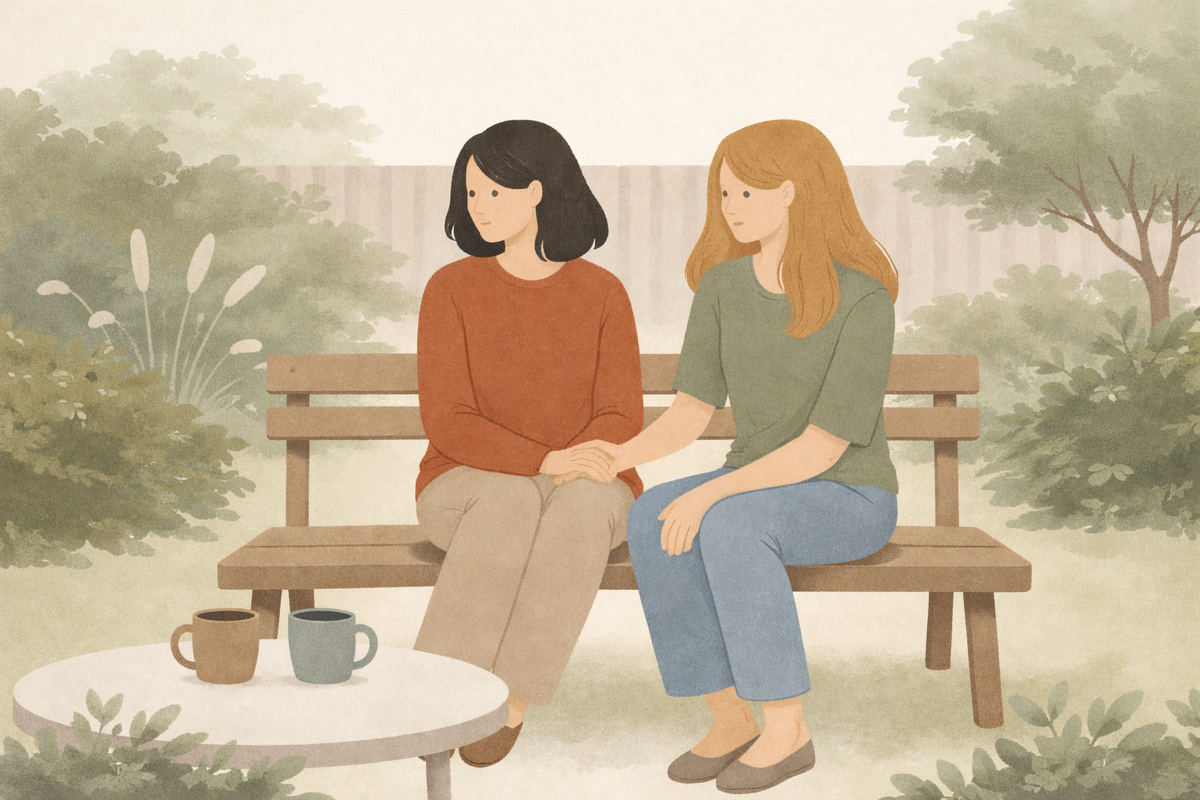
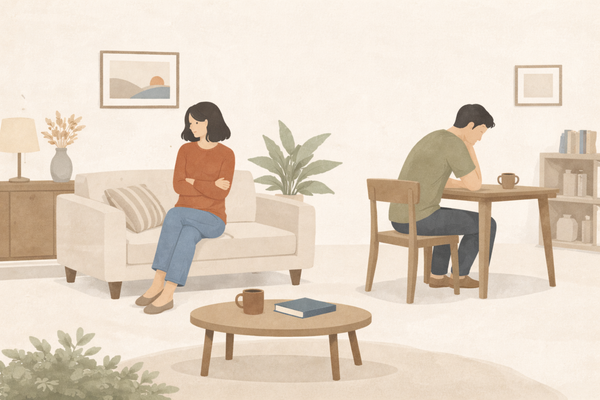
You still function well as a couple. You manage the house, the schedules, maybe the kids. You talk every day, logistics, plans, things that need to get done. And on many levels, things are fine. And yet, something feels different. Quieter than it used to be. A little more distant.
Maybe one of you says, "We don't really connect anymore." The other is thinking, "We barely touch." You try to fix it: you talk more, or you initiate more often physically, but nothing quite shifts. Instead, you start to feel like you are reaching for each other and somehow missing.
This is often where the question begins: what is actually missing? Emotional intimacy? Physical intimacy? And more importantly, are these even the same thing? The honest answer is that they are not. The most common intimacy problem in long-term relationships is not that couples have stopped wanting each other. It is that they are reaching for different things and calling both of them intimacy.
What is the difference between emotional and physical intimacy?
What this article covers
- Is the emotional vs physical intimacy gap more common than couples admit?
- What is the difference between emotional intimacy vs physical intimacy?
- Why doesn't emotional closeness automatically lead to physical desire?
- Which comes first: emotional or physical intimacy?
- How do stress and modern life quietly erode both types of intimacy?
- What is the pursue-withdraw dynamic and why does it matter?
- Why do couples often mislabel what's missing?
- You're not broken, you're misaligned
- Rediscovering connection without pressure
- Frequently Asked Questions (FAQ)
Is the emotional vs physical intimacy gap more common than couples admit?
Most long-term couples hit a point where the balance between emotional vs physical intimacy shifts in ways neither partner fully anticipated. If you've been together for years and intimacy feels uneven, unclear, or just off, you are far from alone. Most long-term couples move through periods like this. Not because their relationship is broken, but because intimacy is not a static thing. It evolves, changes shape, and sometimes quietly gets out of sync with what each partner actually needs.
The problem isn't usually that the love is gone. It's that the tools couples use to reconnect no longer match what's actually missing. And that's a much more hopeful starting point.
For a broader look at why lack of intimacy develops and what genuinely helps, see our guide on lack of intimacy in a relationship.
What is the difference between emotional intimacy vs physical intimacy?
Emotional vs physical intimacy are not two sides of the same coin. They answer different questions, respond to different conditions, and fade for different reasons.
At first glance, these two things feel inseparable. And in many ways they are. But they operate through very different channels, and they serve different psychological needs.
Emotional intimacy: "Am I safe with you?"
Emotional intimacy is the feeling of being truly known: seen, understood, and accepted by another person. It's built in small, often unremarkable moments: sharing something vulnerable, being really listened to, feeling that your partner gets you even when you're not at your best.
As therapist Sue Johnson, founder of Emotionally Focused Therapy (EFT), describes it, emotional intimacy creates a sense of attachment security: a deep, bodily knowing that you are not alone. When this is present, the relationship feels like a safe harbour. When it's absent, even the smallest interactions can feel tense or hollow.
Physical intimacy: "Do you still want me?"
Physical intimacy includes touch, affection, and sexual connection, but it goes beyond mere closeness. At its core, it answers a different question: Do you still want me? It carries desire, aliveness, and the felt sense of being chosen.
This is why physical intimacy can sometimes feel fragile in ways that emotional intimacy doesn't. It's not just about being loved. It's about being desired. And that distinction matters more than most couples realise. This is the heart of the emotional intimacy vs physical intimacy question. Not which one is more important, but how they each answer a fundamentally different need.
A note before you begin reflections
There are a few short reflection exercises in this article. If you are the partner who tends to notice these things first, who reads the articles, who carries the awareness of the relationship, they are not more work for you to do alone. They are most useful when they eventually belong to both of you.
If your partner is not ready to hear this yet, or responds in a way that closes things down rather than opens them, that is not a failure. Sometimes the first time you try is the practice, not the conversation itself.
✦ Pause and Reflect#1: two kinds of close
For yourself
Think of a recent moment, or one from further back, when you felt genuinely emotionally close to your partner. Not a perfect moment. Just one where you felt seen. Where was it? What was happening? What was the feeling in your body?
Now ask the same question about physical intimacy. And not just about touch, but about feeling wanted. When did you last feel that? What made it land as wanting, rather than as routine?
To bring to your partner:
Something you could say: "I've been thinking about what makes me feel close to you, and what makes me feel wanted by you. I don't think they're the same thing for me. Can I tell you what I noticed?"
Notice whether your two answers are about the same kind of moment or two different kinds. For most people they're different. That difference is usually the beginning of the real conversation.
Why doesn't emotional closeness automatically lead to physical desire?
This is one of the most important things to understand about emotional vs physical intimacy in long-term relationships: feeling emotionally close to your partner does not automatically generate physical desire. And understanding why is important.
It seems logical that closeness should lead to intimacy in all its forms. But as therapist and author Esther Perel has explored extensively, long-term intimacy contains a paradox. We want two things that are, in some ways, in tension with each other. We want security, comfort, and deep familiarity. And we also want novelty, mystery, and the feeling that our partner is not entirely predictable to us.
Emotional intimacy is nourished by safety and predictability: I know you. You know me. We are steady. But physical desire often needs something slightly different: I'm still curious about you. You still surprise me.
These are not opposing forces, they can absolutely coexist. But in long-term relationships, as life becomes more structured and the relationship more familiar, the conditions for desire can quietly disappear. Not because love has faded. But because the erotic side of a relationship needs a different kind of tending than the emotional side does.
Biological anthropologist Helen Fisher, whose research at the Kinsey Institute has examined the neuroscience of love across cultures, adds another layer worth understanding. She identifies three distinct biological systems involved in romantic relationships. Lust is driven largely by testosterone, romantic attraction by driven by dopamine and norepinephrine, and attachment by oxytocin and vasopressin. These three systems evolved to serve different purposes, and, importantly, they can operate somewhat independently of each other. This is why you can feel profoundly bonded to your partner, the attachment system firing strongly, while the systems that produce desire and attraction have quieted. It is not a contradiction. It is biology doing three different things at once. Understanding this tends to take some of the moral weight off the experience of loving someone deeply and not feeling desire for them in the way you once did.
There is another piece of this that rarely gets discussed openly, and it tends to bring significant relief when it does. Lisa Diamond, a psychologist at the University of Utah whose research has tracked how desire evolves across the lifespan, found that sexual desire is considerably more fluid and context-dependent than cultural narratives suggest. It shifts with life stage, hormonal changes, stress, the state of the relationship, and a dozen other factors most people never track consciously. Her work challenges an assumption that causes real suffering in long-term couples: the belief that if desire has changed, something must be fundamentally wrong, either with the person or with the relationship. Diamond's research suggests something simpler and more accurate. Desire is not a stable trait. It is a response, and responses change. Recognising this tends to remove a great deal of self-blame from the conversation, particularly for partners who have quietly wondered if they are somehow broken.
Which comes first: emotional or physical intimacy?
This is the question at the heart of most long-term intimacy struggles, and it is the one most couples do not quite get to ask out loud. Because inside it is a very specific kind of stuck.
One partner thinks: I need to feel emotionally close before I can want sex. The other feels: I need physical connection to feel emotionally close. Both of these experiences are completely valid. But together, they create a standstill. Neither person moves first. Or when one does, the timing feels wrong to the other. This is what might be called the which comes first loop, and it is one of the most common dynamics in couples who still love each other but feel unable to reach each other.
Understanding why this loop exists, and what actually moves it, requires one specific piece of research that changes the conversation once you encounter it.
Spontaneous desire arrives on its own, without a specific trigger. The kind of desire most cultural messaging treats as the norm. Responsive desire emerges in response to connection, touch, or a shift in emotional tone. Emily Nagoski's research at the Kinsey Institute found that most people in long-term relationships experience desire responsively rather than spontaneously. It is not a lesser or broken form of desire. It is the norm. What this means for couples is significant: if you are waiting to feel desire before you reach for each other, you may be waiting for something that does not arrive that way anymore. The desire is not gone. It is simply waiting to be prompted by closeness, rather than preceding it.
The difficulty in long-term relationships is that when both partners are waiting to feel something before they act, the conditions for feeling that something never quite arrive. The gap between emotional and physical intimacy widens here, not because either dimension has disappeared, but because each partner is waiting for the other to arrive first. The loop keeps turning. Days pass. Weeks pass. Neither partner is being cold or disinterested. They are simply both waiting for a feeling that, for many people in long-term relationships, will not show up until after the movement toward each other has already begun.
Basson's circular model: the sequence most couples do not know about
Gynaecologist and researcher Rosemary Basson developed what has become one of the most clinically influential models of sexual response in long-term relationships. Her circular model proposes something that directly contradicts the assumption most couples carry: for many people, particularly in established partnerships, desire does not precede closeness. It follows from it.
The sequence Basson identifies tends to be: emotional intimacy first, then a willingness to be open to physical connection, then arousal, and only then desire in the form most people recognise. This is almost the opposite of what most cultural messaging suggests, which tends to imply that desire should arrive spontaneously, and if it does not, something is wrong.
What this means practically is significant. Waiting to feel desire before reaching for closeness often keeps desire permanently out of reach. The willingness itself, approached without pressure, is often what allows the rest to follow. For couples stuck in the which-comes-first loop, the shift is not from waiting to wanting. It is from waiting to willingness — a small, quiet openness to closeness that does not require feeling anything in particular first.
✦ Pause and Reflect #2: which comes first for you
For yourself:
Do you tend to need emotional closeness before physical desire can show up? Or does physical connection help you find your way back to emotional closeness? Neither way is better. They're just different, and many couples have one of each without ever naming it, which means both people end up waiting for the other to arrive first.
If desire has felt harder to access lately, try this: what condition would need to be in place first? Not a performance. An actual condition: safety, ease, a particular kind of presence, the sense that nothing is being measured.
To bring to your partner:
Something you could say: "I think I understand a bit more about what I need before I can feel close to you. Can I share it? And I'd really like to hear what's true for you, too."
How do stress and modern life quietly erode both types of intimacy?
One of the most overlooked reasons that emotional intimacy vs physical intimacy both fade at the same time is not a relationship problem at all. It is a nervous system problem. And at its root, something simpler: exhaustion.
Chronic stress, mental overload, and the relentless pace of modern life affect the body and the nervous system in ways that directly suppress both emotional presence and sexual desire. When your system is constantly in a low-grade state of alert. Managing work, children, finances, endless small decisions, there is simply less available for connection.
You may notice that you have less patience, less energy, less interest in closeness of any kind. This is not rejection. It's depletion. But it is very easy to misread. A partner who pulls away when stressed can look, from the outside, like someone who has lost interest. When in reality they are simply running on empty.
David Schnarch, a psychologist known for his work on intimacy and differentiation, observed that many couples who struggle with desire are not emotionally disconnected—they are overwhelmed. They've become excellent at functioning together. But functioning and connecting are not the same thing. And when life is relentlessly full, connection is often the first thing to get quietly set aside. Both emotional vs physical intimacy require conditions that chronic stress systematically removes: ease, presence, and the sense that there is enough space for another person.
What is the pursue-withdraw dynamic and why does it matter?
When the balance between emotional and physical intimacy tips too far in either direction, a particular relational dynamic tends to emerge. One partner reaches for connection. The other, feeling overwhelmed or pressured, pulls back. The first partner, now feeling more anxious or rejected, reaches again, perhaps more urgently. The second withdraws further. Over time, what started as a simple mismatch in timing becomes a loaded dynamic. Touch feels like a demand. Conversation feels like a test. Even small gestures of affection carry a weight they were never meant to carry.
This is what Sue Johnson describes as the pursue-withdraw cycle. In the context of emotional vs physical intimacy specifically, it has a particular quality: the two partners are often not just reaching with different intensities, but for different things. The pursuing partner may be reaching primarily for emotional closeness, which they experience as safety. The withdrawing partner may be pulling back from what feels like pressure around physical closeness, which they experience as demand. Each is responding to the other's language as if it were their own, and each is reading the other's retreat through their own frame.
Intimacy hunger, sometimes called emotional starvation, is the sustained experience of reaching toward a partner and consistently not being met. It is not neediness, although it often gets labelled that way, including by the person experiencing it. It is the natural response of a nervous system that has evolved to seek and maintain close bonds. When those bonds feel intermittent or distant, the system registers something real and begins to signal for more contact. The pursuing partner is not broken. They are responding, accurately, to a genuine relational reality.
For a fuller treatment of how the pursue-withdraw cycle works, what each partner is actually experiencing, and what begins to loosen its grip, see our article on the effects of lack of intimacy.
Why do couples often mislabel what's missing?
When intimacy feels off, most couples reach for the most visible symptom and try to fix that. We need more sex. We need to talk more. We need more quality time. These are not wrong instincts. But they often address the surface rather than what's underneath.
As John and Julie Gottman, one of the most influential relationship researchers of the past several decades, has shown, emotional connection is built through small, often overlooked moments, what he calls bids for connection. A comment, a touch, a glance that says I see you. When these bids are consistently missed or turned away from, not out of cruelty, but out of distraction, stress, or habit, emotional distance accumulates quietly, long before either partner names it as a problem.
And what looks, eventually, like a physical issue often traces back to a long trail of small emotional disconnections. Just as what looks like an emotional issue sometimes needs physical warmth to begin to thaw.
The two are linked. But they are not the same thing. Naming whether the gap is primarily in emotional vs physical intimacy, rather than assuming both have faded equally, changes what kind of attention the relationship actually needs. And also naming which one is actually hurting, rather than assuming, changes the kind of care that's needed.
If you want to understand what that accumulated distance actually does to each partner over time, our article on the effects of lack of intimacy goes deeper.
You're not broken. You're misaligned.
Most couples who feel stuck in the tension between emotional vs physical intimacy are not incompatible. They are misaligned, often in ways that are entirely workable once named. Here is perhaps the most important reframe this article can offer.
Many couples interpret a change in intimacy as evidence that something is fundamentally wrong. That they've grown apart, that they're incompatible, that the love has changed into something lesser. And that interpretation, understandable as it is, tends to make things worse. It adds shame and urgency to something that already feels fragile.
But in most cases, what's actually happening is simpler: two people who love each other have drifted into misalignment. They define intimacy slightly differently. They need it at different times. They speak different emotional languages. They're running on different levels of energy. These are not signs of failure. They are the natural friction of two full lives being lived alongside each other.
The difference between broken and misaligned is the difference between despair and possibility. If you're still trying to find words for what exactly feels missing, it helps to start with what lack of intimacy actually means.
✦ Pause and Reflect #3: the first honest answer
For yourself:
Put a hand on your chest or your stomach. Take one slower breath than usual. Then finish this sentence, and keep the first honest answer even if it surprises you: "What I most want to feel with my partner right now is..."
It might be safety. Desire. Ease. Lightness. The feeling of being chosen. Something you can't quite name yet. Whatever arrives, let it be there.
If a second sentence comes up like "and I'm a little afraid to say it", that belongs here too. The fear and the longing almost always travel together.
To bring to your partner:
Something you could say: "There's something I've been feeling that I want you to know. I'm not asking you to fix it. I just want you to hear it."
If it doesn't land the way you hoped, that doesn't erase what you said. Sometimes partners need time to metabolise something before they can respond to it well.
Rediscovering connection without pressure
Restoring emotional or physical intimacy, or both, does not require urgency. It requires something quieter. Intimacy in a long-term relationship does not need to be forced back into place. Pressure, urgency, and the feeling that you need to fix this now are often the things that keep connection furthest away.
What tends to help, instead, is a kind of gentle curiosity. About yourself: what you are feeling, what you are carrying, what you actually need. About your partner: who they are right now, what they might be struggling with, what they might be longing for that they have not said. About the space between you, not as a problem to be solved, but as something that can, slowly, be moved through.
Emotional intimacy and physical intimacy are different languages. And like any language, they can be misread, even between two people who love each other deeply. The goal is not to choose one over the other, or to make one happen before the other can follow. It is simply to become more fluent: in your own needs, in your partner's, and in the quiet ways the two of you have always been trying to reach each other.
Because often, what feels like distance is not a distance at all. It is a signal. Not that something is lost, but that something is asking to be understood differently. And from that understanding, connection tends to find its own way back.
What to remember
#2 Feeling emotionally close to your partner does not automatically produce physical desire. For most people in long-term relationships, desire is responsive. It emerges from connection rather than preceding it.
#3 Most couples stuck in this territory are not incompatible. They are misaligned. Each reaching for something the other does not recognise.
#4 What shifts things is usually not more effort, but the willingness to notice which question has stopped being answered between you.
Where to go next
Depending on what you have recognised in this article, a few different next steps may help.
If you have realised that emotional intimacy is the dimension that has gone quiet for you, and you want to understand what that quietness does to each partner over time, our article on the effects of lack of intimacy goes deeper.
If you have recognised yourself in the which-comes-first loop and want to understand how to begin stepping out of it, our article on how to rebuild intimacy in a relationship looks at what actually works, including the shift from waiting to willingness.
If the distance you are feeling is more texture than content, if the relationship has started to feel more like a shared household than a partnership, our article on why your relationship feels like roommates explores that specific dynamic.
Frequently Asked Questions (FAQ)
What is the difference between emotional intimacy and physical intimacy?
Emotional intimacy is the felt sense of being truly known and accepted by your partner. Physical intimacy is the felt sense of being desired. Both are essential in a long-term relationship. However they operate through different channels and are not automatically produced by each other, which is why couples can lose one while still having the other.
Can you have physical intimacy without emotional intimacy?
Yes, and many couples do, at least for a while. The relationship between emotional intimacy vs physical intimacy is not one of simple cause and effect. Having one does not guarantee the other. But when emotional intimacy is low, physical intimacy tends to feel hollow or pressured over time. The felt sense of being desired is hard to sustain when the felt sense of being known is absent. Most couples find that emotional safety is a prerequisite for physical closeness to feel meaningful.
Why do I feel emotionally close but not physically attracted to my partner?
This is more common than most couples admit, and it does not mean something is wrong. Long-term familiarity can suppress desire even when love is strong. Desire often needs a degree of separateness and curiosity that domestic closeness tends to gradually reduce. It is not a sign of incompatibility. It is a sign that desire needs different conditions than love does.
Which comes first: emotional or physical intimacy?
For most people in long-term relationships, emotional safety tends to come first. Emily Nagoski's research on responsive desire shows that physical desire often emerges in response to connection rather than arriving spontaneously. However, for some people physical closeness is what opens the door to emotional intimacy. Understanding which pattern applies to each partner is one of the most useful conversations a couple can have.
How do you rebuild both emotional and physical intimacy at the same time?
The most consistent research finding is that small moments of genuine responsiveness matter more than grand gestures. Responding to a partner's bid for connection, a comment, a look, a question, begins to rebuild emotional safety. From that safety, physical closeness tends to follow more naturally. Pressure to restore both simultaneously is usually counterproductive. Ease and curiosity are better starting points than urgency.
About the research
This article draws on work by Emily Nagoski, Rosemary Basson, Esther Perel, Sue Johnson, Helen Fisher, Lisa Diamond, David Schnarch, and Julie Gottman.
Written by the BetweenUs editorial team. We write about long-term relationships, intimacy, and desire, grounded in psychological research, without quick fixes.